



• Smart Keyword Filtering uses AI to understand meaning, not just exact words, giving users more effective control over what they see.
• The feature strengthens trust by reducing unwanted content without extra effort from users.
• Fast, cross-functional collaboration and strong internal tooling enabled rapid global rollout.
• This work reflects TikTok’s commitment to safety-first, user-centric innovation.
• Smart Keyword Filtering uses AI to understand meaning, not just exact words, giving users more effective control over what they see.
• The feature strengthens trust by reducing unwanted content without extra effort from users.
• Fast, cross-functional collaboration and strong internal tooling enabled rapid global rollout.
• This work reflects TikTok’s commitment to safety-first, user-centric innovation.
Smart Keyword Filtering is an advanced content-control feature designed to help TikTok users personalize and protect their viewing experience. Unlike traditional keyword filters that rely on exact text matching, Smart Keyword Filtering intelligently expands user-defined terms into related concepts, slang, and variations. This ensures that filtering is more effective, intuitive, and aligned with how humans think, not how computers historically process language. The feature reflects TikTok’s commitment to user trust, safety, and responsible innovation at global scale.
Challenge
Over 23 million daily active users had previously filtered at least one keyword. Yet many continued to report seeing related content that should have been blocked. The legacy system had a major limitation:
- It matched literal strings only
- Reliance solely on content description
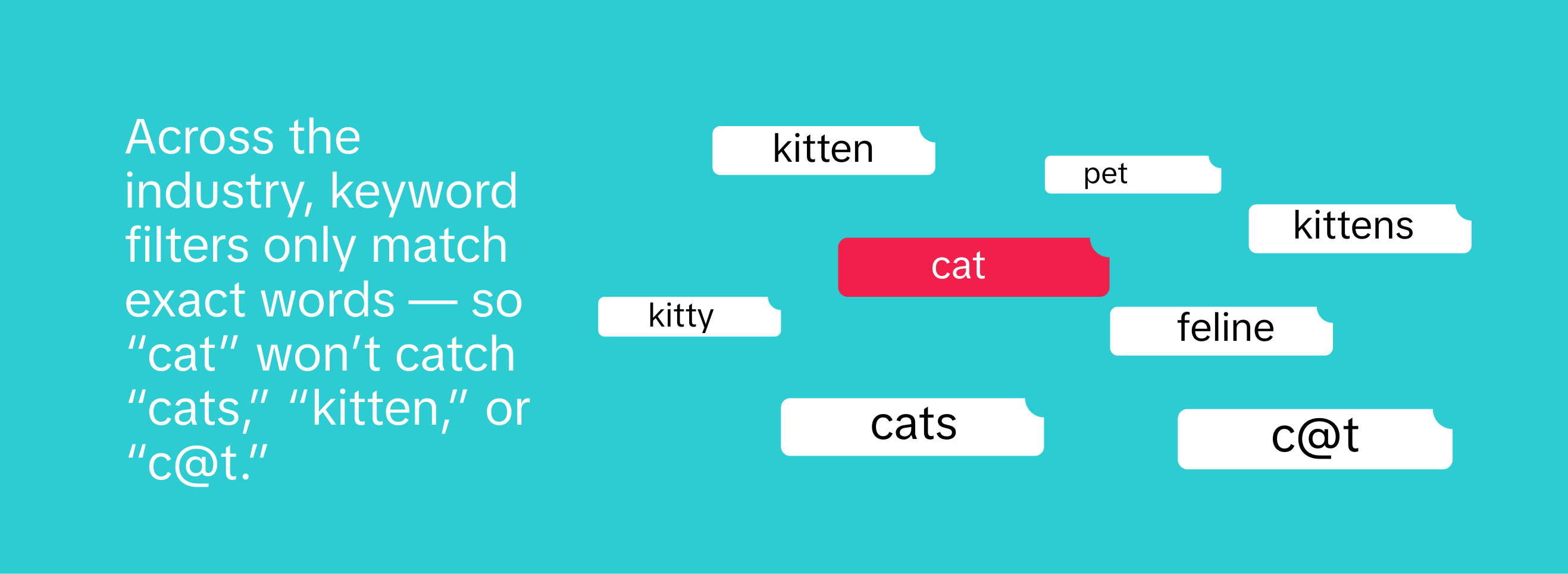
- It could not understand spelling variants, slang, or conceptual relationships. For example: If a user blocked “cat,” they might still see: “kitten”, “c@t”, hashtag variations, related terminology
Without sufficient contextual awareness, users were required to over-specify rules, leading to ineffective controls and unpredictable outcomes.
This led to:
- Unintended results
- Declining user adoption
Insights
Users think in concepts, not exact strings, and content filtering must reflect that. Both the engineering and product teams recognized:
- Humans block ideas, not specific spellings
- Filtering should interpret meaning and context
- Safety tools must reduce user burden, not increase it
This led to a vision: Empowering users to better adjust their content experience with contextual, intuitive and low effort solution.
Solution
Smart Keyword Filtering uses AI and large language models (LLMs) to automatically expand user-blocked keywords into related terms, synonyms, slang, and contextual interpretations sourced from captions, content descriptions, and alt-text.
Key Improvements
- No need for users to guess every variation
- Filters scale intelligently with meaning-based terms
- More consistent and holistic control of viewed content
Users still manage filtering the same way, but the system makes it far more effective.
Core Benefits
- Smarter
- More reliable
- Easier to use
- Trust-reinforcing
Technical Approach
Development leaned heavily on TikTok’s tightly integrated internal ecosystem, enabling rapid, reliable scaling. The technical approach centered around:
- Building once, deloy cross-platform (Anroid + iOS)
- A/B testing at massive scale
- Feature delivery tracking
- High-velocity design iteration
- Real-time global collaboration
Internal experimentation frameworks allowed allowed for safer validation across diverse user populations. This infrastructure uniquely enabled TikTok to:
- Build quickly
- Test thoroughly
- Scale globally
- Maintain strong trust + compliance
- Few companies can execute this kind of concept-to-global-launch motion at such speed

Team Approach
- Data first, ego last
- Candid communication
- Shared ownership: everyone owned the outcome
- Fast iteration: if something broke, it was fixed next sprint
- Intense yet creative; high velocity without silos
This made the initiative feel like a collective achievement rather than isolated contributions.

Results & Impact
Smart Keyword Filtering delivered immediate, measurable improvements on user experience:
- Fewer reports of unwanted content
- Reduced dislikes
- Higher satisfaction
- Greater sense of control
- Stronger trust in TikTok safety tools
Users now experience filtering that behaves the way they expect without extra work.

Key Learnings
1. Engineering Perspective
- Innovations that expand user safety create meaningful impact
- Cross-platform tools (e.g., LynxJS) accelerate delivery without compromising consistency
- Integrated infrastructure enables world-scale launch with reliability and compliance
- The most rewarding impact: users feel safer and more in control
2. Product Perspective
- AI can bridge human thinking with system logic
- The best features reduce user effort while increasing control
- User trust is a critical success metric
- Fast experimentation + global distribution enables real-world problem-solving at speed
Conclusion
Smart Keyword Filtering is more than a feature, it’s a shift in how platforms interpret user intent. By leveraging AI to understand meaning rather than literal text, TikTok delivers more intuitive, effective safety tools that strengthen user trust at scale. Its success is proof that:
- Responsible innovation scales
- User empowerment drives satisfaction
- Trust is earned through thoughtful technology
Smart Keyword Filtering demonstrates TikTok’s position as a leader in building a safer, most user-first platform on the planet and marks an important step toward smarter, more human-aware digital experiences.
For those inspired by this kind of work, TikTok is always looking for engineers who care deeply about impact, safety, and user-centric innovation. Explore our open roles.

