Join us as we inspire
creativity and bring joy to
millions of users worldwide.
Join us as we inspire
creativity and bring joy to
millions of users worldwide.

@2026 TikTok
Our teammates make our culture creative, collaborative, and innovative.Explore our blog for an inside look at #LifeAtTikTok.
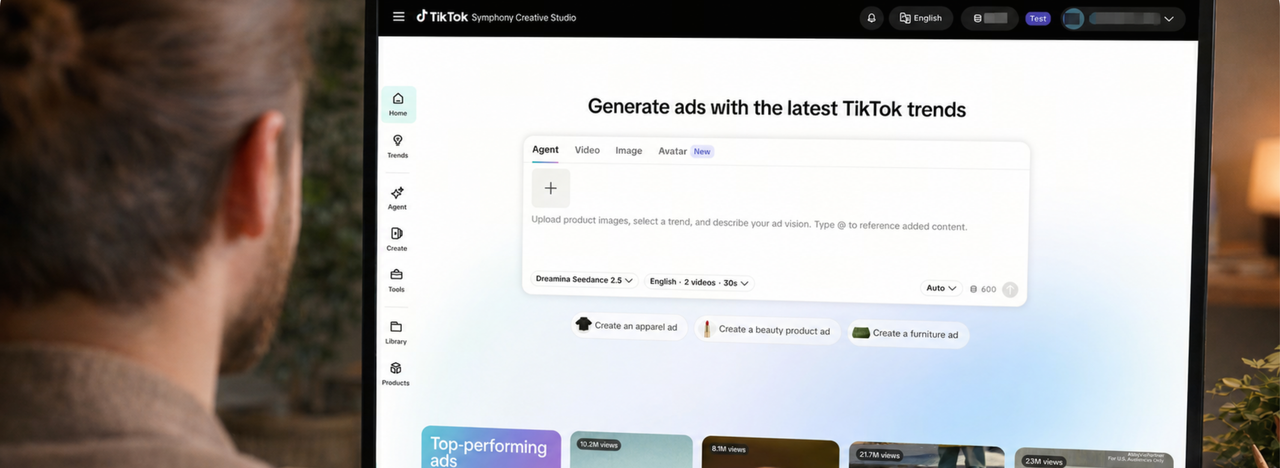
One of the hardest challenges advertisers face in the digital ecosystem today is how to generate high-quality, culturally relevant and personalized content to reach diverse global audiences at scale and in real time. TikTok Symphony aims to tackle this question by using a generative AI-powered creative system designed to transform how content is produced, optimized and scaled.
Our engineers developed Symphony as a distributed, AI-native creative infrastructure that connects ideation, generation and optimization into a continuous loop. By combining generative models, platform intelligence and performance feedback systems, Symphony turns creative production into a programmable and flexible system enabling advertisers to create and iterate content with ease.
Challenges
Given the increased need to scale creative advertisement solutions, the underlying demands on systems have fundamentally changed:
1. Creative demand has shifted from static to continuous generation
Creative is now a high-frequency input into the ads system. Instead of one strong asset, campaigns require multiple variations running in parallel, continuously refreshed and adapted across audiences, formats, and markets. Instead of creating one asset per campaign, you are now constantly producing and evolving multiple versions. At that scale, what matters is both quality and how quickly you can iterate.
2. The current production model doesn't scale
Today, creative production for ads still follows a pretty linear path: from brief to script to production, then editing and localization. This works for a small number of assets, but breaks under high variation:
As a result:
The shift: creative production becomes a systems problem
At this scale, the bottleneck is the system, not ideas. Solving this requires systems that can generate content, improve it based on performance, continuously learn through feedback loops, and reliably deliver it at scale. The real challenge is not each part on its own, but how they work together as a connected, continuous loop.
Solution: Symphony as a Creative System
At TikTok, we stepped back and rebuilt creative production as a system.
The challenge wasn't a lack of ideas, it was that traditional workflows couldn't keep up with the speed, scale, and complexity required today.
So we built Symphony, an AI-native platform where generation, optimization, and delivery are fully connected in a continuous loop. Creative for advertisement becomes dynamic, adaptive, and constantly improving based on real-time performance. What was once a manual, linear process is now programmable, scalable, and designed to evolve.
How the system works
Symphony is built as a set of connected systems that work together, each solving a different part of the problem, but designed to operate as one loop.
Generation: creating content at scale
The first challenge is generating content that is engaging and platform-native. Symphony uses generative models to turn inputs like product data, URLs, or prompts into ready-to-use creatives. This includes scripts, videos, AI avatars, and voiceovers. The technical challenge here is quality beyond scale. Generating thousands of assets is easy. Generating content that feels relevant, avoids repetition, and fits platform behaviour is much harder.
Optimization: improving what actually works
Once content is generated, it doesn't stop there. Symphony continuously evaluates performance and uses those signals to improve creative. This includes generating new variations, refining hooks, adjusting pacing, and applying format-specific fixes. Instead of relying on manual iteration, the system creates a feedback-driven loop where content evolves based on real engagement.
APIs: making the system programmable
To support scale, Symphony exposes its capabilities through APIs. This allows teams and advertisers to integrate generation, transformation, and optimization directly into their own workflows. Instead of producing creatives manually, they can build pipelines that continuously generate and adapt content. This shifts creative production from a one-off task into something that can be automated and orchestrated.
Automation: closing the loop
The real power of Symphony comes from how these pieces connect. With automation, the system can generate content based on campaign context, evaluate performance in real time, and trigger the next iteration automatically.
This includes use cases like daily creative generation, real-time iteration, and recommendation systems that suggest what to produce next.
At this point, Symphony becomes a full suite of AI tools embedded with TikTok Ads Manager and built for scaled content.
What makes this challenging from an engineering perspective?
Building Symphony means working across multiple domains. It sits at the intersection of AI and infrastructure, where models, systems, and scale all need to work together in real time. You are solving for:
How it's built
Under the hood, Symphony combines generative AI models, transformation pipelines, and optimization systems, all tightly integrated with platform data.
Generative models handle content creation across text, video, and speech. Transformation pipelines adapt content through translation, dubbing, and media conversion. Optimization systems use performance signals to score, rank, and generate new variations.
All of this is supported by an API-first architecture, allowing the system to scale and be orchestrated across different use cases.
The result is a connected system where generation, optimization, and delivery continuously inform each other.
Results & impact
What this unlocks shows up at both the system and performance level.
Generation and iteration are built into the system, removing the need for manual asset production and refresh cycles. Creative becomes a continuous process where content is generated, tested, and updated in place.
This increases the rate of experimentation. More variations mean faster feedback loops, allowing the system to identify and scale what works more efficiently. In practice, this has led to measurable improvements, including up to 1.5x return on ad spend (ROAS), along with reduced time and cost per asset.
More importantly, the structure changes: Creative is no longer treated as a final output, but as a system that evolves over time, with performance data directly informing how content is generated and refined.
What used to be a linear pipeline becomes a loop. Each cycle feeds the next.
Conclusion
The challenges are real, and so is the impact. The systems built here shape how content is created, how teams work, and how people experience the platform at scale.
As an engineer, you will be working in a space that's still being defined, building how creative gets produced, improved, and scaled in real time. The work brings together engineering, product, and applied AI, with the challenge of making these pieces truly work together, connecting generation, feedback, and delivery into one continuous system.
This is a space that's still being defined. There are no fixed patterns for how creative systems at this scale should work. As an engineer, you are connecting AI models with large-scale infrastructure to support how creative is generated, tested, and improved.
If you are interested in working on problems that combine real-time systems, multimodal AI, and large-scale infrastructure and seeing your work directly impact how content is created and consumed globally, this is the kind of challenge you would be stepping into. Explore open roles now.